When Satellite Imagery Lies: How a Farm Field Became a False Alarm for Urban Green Loss
An essay on creative attention, ground truth, and learning to see clearly.
We sit in front of glowing screens, believing that distance grants us clarity. From hundreds of kilometers above the Earth, satellite sensors quietly trace the contours of my world—measuring light, reflecting wavelengths, calculating indices of life. It is easy to mistake this high-altitude abstraction for truth. But the map is never the territory, and the algorithm has no eyes for context.
For months, my project, Green Letters, has been driven by a singular, passionate intent: to act as an attentive witness to the quiet erasing of urban green space—alerting subscribers whenever concrete threatened to swallow grass, trees, or neighborhood wildness. So when thepipeline flagged a dramatic shift in vegetation density in Amsterdam Noord—a widespread blue mask flagging a sudden gain in greenery across a wide swath of land—the data seemed intriguing. Was a new urban green space rapidly flourishing?
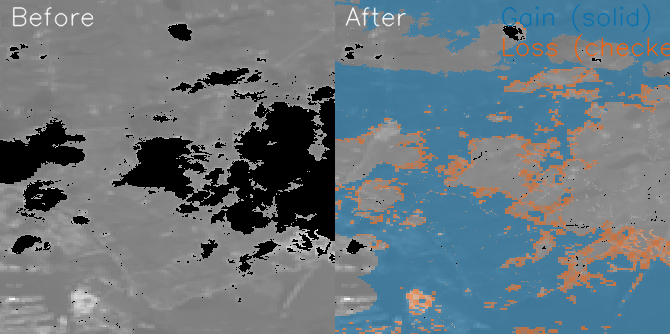
Figure 1: The satellite's high-altitude perspective. A pixelated landscape of "gain" and "loss" masks (blue and orange-checkered) overlaying an area in Amsterdam Noord across a 3-day interval.
The Journey: A Morning Bike Ride from Amsterdam Oost
Getting satellite alerts for my city and setting out on two wheels to inspect them with my own eyes had been a dream of mine all along. But I knew Green Letters was still in its early verification phase. When this change was processed and flagged for my email newsletter, I fully anticipated a mistake—and that was precisely why I wanted to go. The goal wasn't just to sightsee, but to diagnose the false positive in person, understand why the pipeline got confused, and engineer a fix for next time. I treated the ride as both a technical field audit and a trip, stepping away from the screen and stepping into the landscape.
I mounted my bicycle in Amsterdam Oost, heading north. As I pedaled along the leafy tree-lined bike paths, watching early autumn/late summer gold slowly touch the canopy above, the city began to unlock its gentle rhythms. Leaving behind the urban streets, the path stretched straight out toward the open horizon along long dike paths, winding through vibrant green waterways and lush polder stretches.
There is a profound sense of presence that comes from moving through space on two wheels. Capturing photos and short video clips along the way, I could feel the transition from dense city neighborhood to quiet agricultural landscape. The ride itself became a reminder that urban greenness isn't just isolated spots on a map—it is a living, continuous ecosystem we physically inhabit.
The Field Trip to Ground Truth
When I finally arrived at the flagged coordinates in Amsterdam Noord, what I found was not the harsh scrape of bulldozers or the grey expanse of fresh asphalt. It was an open, breathing Dutch polder under a vast sky.
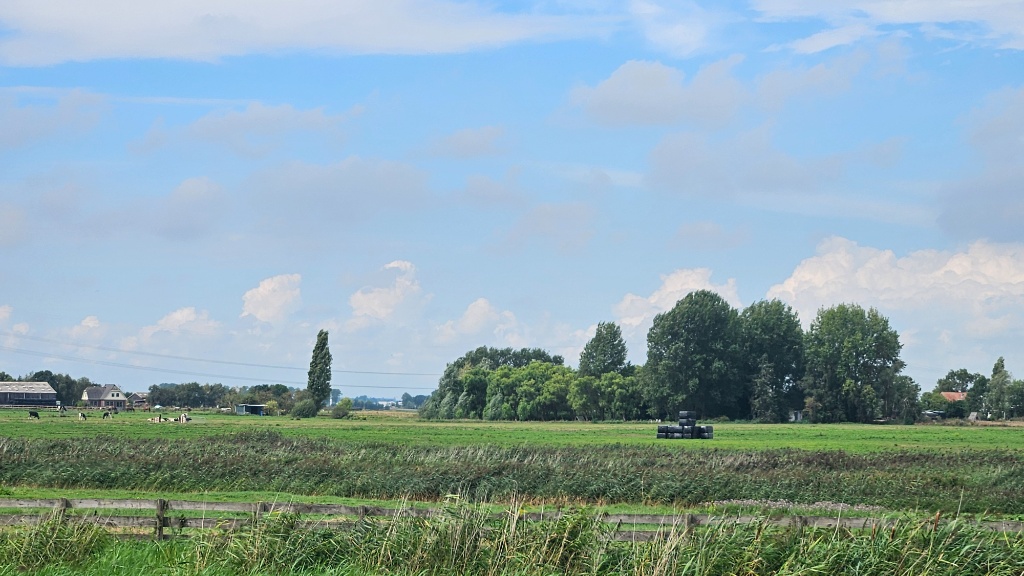
Figure 2: Ground truth. Silage bales, cows grazing, and intact reed ditches.
Standing at the wooden fence, looking past the tall reeds lining the canal, the reality revealed itself with peaceful simplicity: cows grazed calmly on the horizon, black-wrapped hay bales sat stacked like giant ink drops in the distance, and the rich, earthy scent of freshly cut grass hung in the air. The field hadn't been paved over; it had simply been mown.
The satellite had not lied in its raw arithmetic; the pixel values really had registered a sudden gain signal over those three days. But it had misread the meaning of the story. A freshly mown field, flattened grass, and exposed damp soil had created pixel artifacts that our code interpreted as real greenery gain. The mathematical lens was precise, yet utterly blind.
"We must learn to trust our own seeing over the cold authority of abstractions. True creation begins when we lower our binoculars and walk out into the field."
Reframing the Vision: From Panic to Presence
This false alarm was a profound gift. It exposed a crucial flaw in my assumptions: Vegetation loss equals human development. But nature is far more dynamic than my narrow anxieties allow. Fields are mown, crops are harvested, grass turns brown in dry summer heat and springs back green under autumn rains.
If Green Letters was to become a trusted, resonant voice for urban nature, we could not afford to cry wolf every time a farmer cut hay or a lawn went dormant. We needed to teach my code the art of discernment.
This realization broadened my entire project scope. Rather than focusing solely on construction sites, we expanded my lens to encompass urban ecosystem health and climate resilience—tracking heat-stress browning, drought recovery, and true urban tree canopy loss—while consciously excluding routine agricultural maintenance.
Building Discernment Into the Code
Technical architecture: the farmland exclusion filter
To prevent agricultural false positives from triggering alerts across target regions, I integrated an automated land-use filter directly into the change processing pipeline:
- Land-use tagging: Using the Overpass API to query for agricultural tags (
landuse=farmland,meadow,orchard,vineyard,farmyard) within a 50-meter radius of detected change centroids. - Pipeline integration: Any detected change falling inside a farm zone is logged and skipped
- Fail-open resilience: If external API requests time out or fail, the system defaults to processing the region rather than silently dropping real changes, protecting pipeline integrity.
The Lesson of the Mown Field
As creators, developers, and lovers of the Earth, it is tempting to build systems that automate everything—to sit back and let algorithms curate awareness. But technology should refine attention, not replace it. The bike ride from Amsterdam Oost and the mown field in Noord reminded me that ground verification, curiosity, and willingness to amend assumptions are essential to honest work.
By stepping out into the field to dissect early mistakes, I didn't just fix a single alert—I made the entire system smarter. The next time I will look with wiser eyes, and be always ready to hop on my bike